|
Like most Maine libraries of the nineteenth century, the Pittsfield Public Library
began as a subscription library. Subscription libraries offered neither the permanent
collection nor the building that is our modern municipal library; rather, the
subscription library boasted only the bare essentials: books. As they circulated among
towns and communities, collections of books would receive temporary shelter in local
businesses. Townspeople would enjoy each small set of books for a few weeks --
until these volumes were packed off to another village and replaced with a fresh lot.
Unlike the less popular tomes in a permanent library, subscription collections hardly
gathered dust. Nevertheless, limited selections and attenuated access to books provoked
the people of Pittsfield to establish a town library.
Our first full-time library was located on the then Osborn block of Main Street
near the juncture of Main and Hunnewell. The first librarian was a Ms. Bessie Kimball.
Unfortunately, she was left to make bricks without straw, since all the monies allotted
by the town to buy books were used up by the schools -- which stored their holdings
in various places, only one of which was the nascent municipal library. The early
allotments, always in nice round numbers, were not particularly generous. In 1894, the
library survived on a mere $100; in 1900, the book budget had grown to a princely $400.
Nine decades later, in 1993, the library spends $15,000 a year on books; clearly we've
come a long way.
By the turn of the century, the citizens of Pittsfield wanted something more than a
few books squirreled away in a back room. Sometime between 1900 and 1903, three men
approached the Carnegie Foundation with plans to build a large, well-stocked library
building. The Hon. Joseph Manley (of Augusta), Gordon Dobson, and the Rev. L. W. Coons
(both of Pittsfield) convinced the foundation to give the town a grant of $15,000, to be
matched by the citizens of Pittsfield. In meeting, the citizens voted to accept --
and to raise as their portion -- only $10,000. The estate of the late Robert Dobson
gave the town $5,000 that had been held in trust for the building of a library. Because
of state law, Pittsfield was forced to limit its annual library maintenance allotment to
$1,000 per year. Fortuitously, the grant agreement stipulated that only 10%, or $1,000,
of the town's matching funds to be used as an operating budget.
Having settled their funding problems, Pittsfieldians tried to choose a lot for the
library building. Two properties were found to be acceptable to bring to the people for
their selection. The first was the Hackett lot on the corner of Park and Hathorn
streets; the second was the T. G. Lancey lot on the corner of South Main and Railroad.
Which lot won? That Railroad Street is now called Library Street makes it obvious; the
patch of earth that our library currently occupies so majestically is none other than
the old Lancey lot. Even so, the virtues of the Lancey property were not initially
apparent to the people of the town. Citizens complained that this lot, then the site of
a blacksmith shop owned by T.G. Lancey (who also owned the Lancey House Hotel), would be
too noisy, smoky, and sooty from the steam engines on the tracks nearby; a site fine for
metalworking, but atrocious for quiet study. Parents (those living North of the tracks)
worried about the safety of their children, who would have to cross the tracks to get
books. These concerns led to the choice in town meeting of the Hackett lot which won
handily -- 240 to 146. The Lanceyites, however, did not give up. One week after the
first vote, a second meeting was called at which the issue was reconsidered. At this
meeting, William Dobson (brother of Gordon Dobson) gave a speech which brought a 253 to
171 vote in favor of the Lancey lot. Either this speech was amazingly convincing or most
of those living north of the tracks, believing that they had won, had not bothered to
attend the second meeting.
With the site chosen, Pittsfieldians searched for an architect. One Albert
Randolph Ross of New York City was chosen. It is reported that the town's first proposed
design met with Ross's disfavor. The second attempt proved acceptable and Ross drew up
blueprints. In 1903, the Pittsfield Advertiser published an artist's projection of what
the completed building would look like; the artist was not far from the mark. Later that
year, the Advertiser published the blueprints; these newspaper copies are the only
complete set in existence (The Historical Society has the only page of original
blueprint known).
Construction began in 1903. Pittsfield awarded the major contract to M. C.
Foster and Sons of Waterville. Some of the work went to Pittsfield firms: plumbing went
to J. S. Haseltine; steam heat to C. M. Hersey; electrical work to Frank H. Bean. It
would not surprise this author to discover that some or all of the window and door
sashes were from the Bryant Woodworking Company of Pittsfield, which had shops near the
library site. The painting and decorating contract went to Henry B. Washburn of Brewer.
The Dobsons contributed to the decorations by donating various pictures, some of which
were noted in the news accounts of the day.
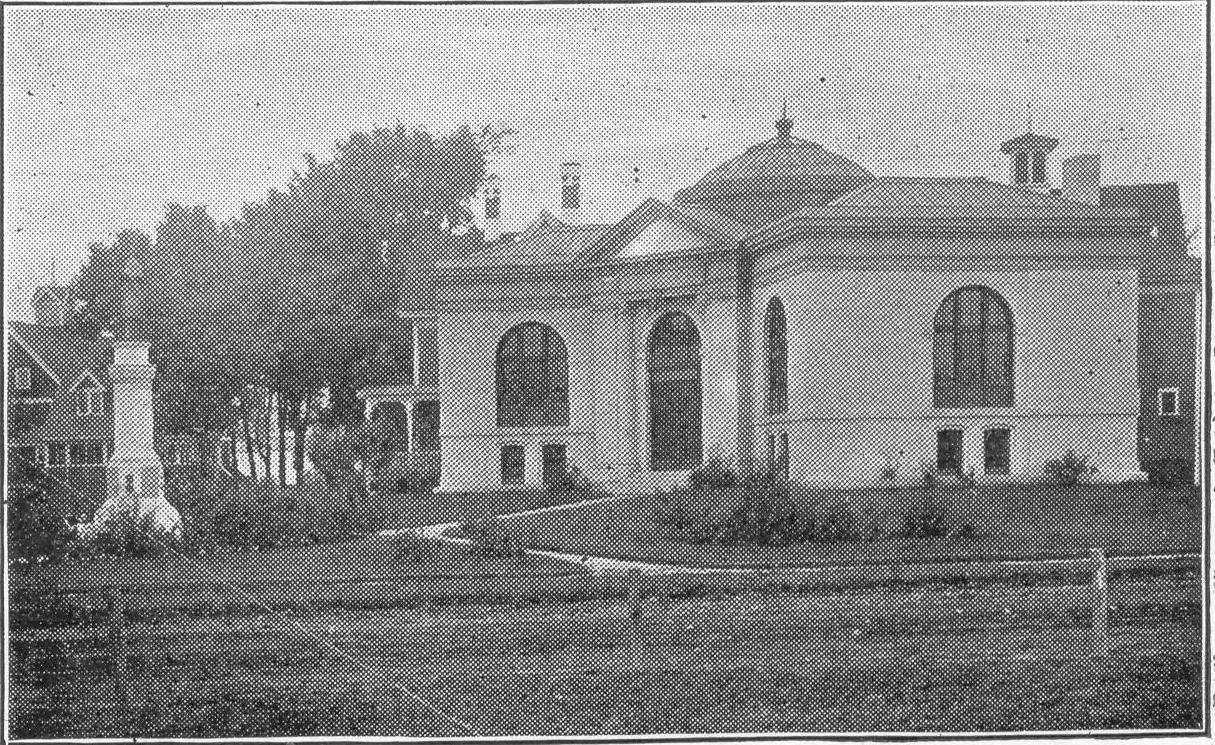
By early May 1904, work had progressed far enough that the
building could accommodate books and furnishings. The library opened to public April,
1904. Construction continued as the builders rushed to finish the library for its
dedication at the end of May. At the same time, the local Grand Army of the Republic
Post of Civil War veterans (Steven Davis Post #11) decided that the front lawn of the
library would be a good place for a memorial to the comrades in arms. The veterans
raised $2,300 for this purpose; the town added $1,000; the memorial, a bronze statue,
was purchased and placed where it is today. The Soldier's Monument was dedicated with
the Pittsfield Public Library on May 28, 1904.
Even after its dedication, the library continued to develop. In addition to those
purchased with town money, books were either bought by the various clubs in town or
given by individuals: the estate of J. W. Manson left a large number of volumes to the
new library. In one instance, a performance of H. M. S. Pinafore was held to raise money
for books. Librarians were usually drawn from the ranks of retired teachers; the single
librarian at any given time was allowed to hire one assistant (who would in turn become
the next head of the library). It was not until 1975, with the retirement of Bessie B.
Libby and Helen Burch, that Pittsfield hired its first professional librarian.
Changes were to occur to the building as well. Over the years, by fits and starts,
the basement was furnished to provide more space for public use. Home to three divisions
of Girl Scouts in the 1940's and 50's, the downstairs stockroom was completed by J. R.
Cianchette. In the 1960's, the local Kiwanis Club made the other large basement room into
a conference room and named it in memory of fellow Kiwanian Joe Buker. In the 1970's, the
Jaycee's finished the kitchen and downstairs bathroom.
By the early 1980's, a single windowed door and entrance lights had replaced the two
solid wooden doors that had previously formed the entrance. Largely through the efforts
of Trudy Humphrey of the Historical Society, 1983 saw the Pittsfield Public Library
added to the National and State Registers of Historic Places. A mural was painted by
Maine humorist Tim Sample.
In the late 1980's, an inspection by the State Fire Marshall revealed that the
building lacked a second upstairs exit; therefore, a window was removed and replaced
with a door. At the same time, the furnace and fuel rooms were partitioned off as
ordered.
This brings us now to the present [1993], and another change at the library, this in
the form of an addition to provide for disabled access as required by the 1990 Americans
With Disabilities Act. This work was started in late summer of 1992 and is still in
progress. It should be completed by 1995 at the latest.
It is this author's wish that all notable happenings concerning the Pittsfield Public
Library be recorded and added to this document.
The Pittsfield Public Library celebrate 100th anniversary May 22, 2004.
Plans for Pittsfield Public Library Circa 1903/04
The only complete set of plans available were published in the Pittsfield Advertiser
around 1903.
Architect: Albert Randolph Ross of New York City, N.Y. Mr. Ross paid a site
visit early spring or summer 1903. This visit influenced Mr. Ross to tear up his first
work on the library (done site unseen) and do another after he had visited the site of
the new library. This second work became the library that we see today. Ground was
broken in late Summer 1903 (Sometime after July 16,1903 is the nearest date that can be
found as nothing about it is mentioned in the Valley Times/Pittsfield Advertiser of the
era.)
Prime contractor was M. C. Foster & Sons, 124 Main St. Waterville, ME (1900-01).
A gentleman named Frank R. Walls was supervisor on site after graduating MCI,
approximately Spring 1892.
Listed in Pittsfield Advertiser. Others are not listed.
Subcontractors were the following (from Pittsfield, unless otherwise stated):
Plumbing: J. S. Haseltine. Moved to Portland by 1905/06.
Heating: C. M. Hersey, 6 Peltoma Ave., Pittsfield, Maine. Out of business by 1905/06.
Painting: Henry B. Washburn, Holyoke St., Brewer, Maine.
Electrical: Frank H. Bean of 9 Libby St., Pittsfield, Maine. (Note: He may
have done this on a subcontract from Central Maine Power Co. & then went out on his own
after the Library Job was done, as prior to 1904 there is no record in the Maine Register
for an electrician by this name in Pittsfield.)
Ground breaking took place in late summer of 1903 (sometime after July 16, exact date
unknown).
Other data on the library must exist somewhere in some form as only one page of the
original blueprints have survived to the present day. This surviving page says:
Drawing No. 2 Work No. 6, Drawn by Allg___ee Walker & R___ Helmer. Mr. Ross's
address was given as 542 5th Ave., NYC, NY.
Any information on the location of other blueprints or names to fill in the above
blanks or any other additional information should be sent to The Pittsfield Historical
Society, Depot House Museum, Inc., P.O. Box 181, Pittsfield, ME. 04967-0181 Atten.:
Pittsfield Public Library Project, D. Hallenbeck, Chairperson.
The date on the plans that the Historical Society has is June 1903.
|